
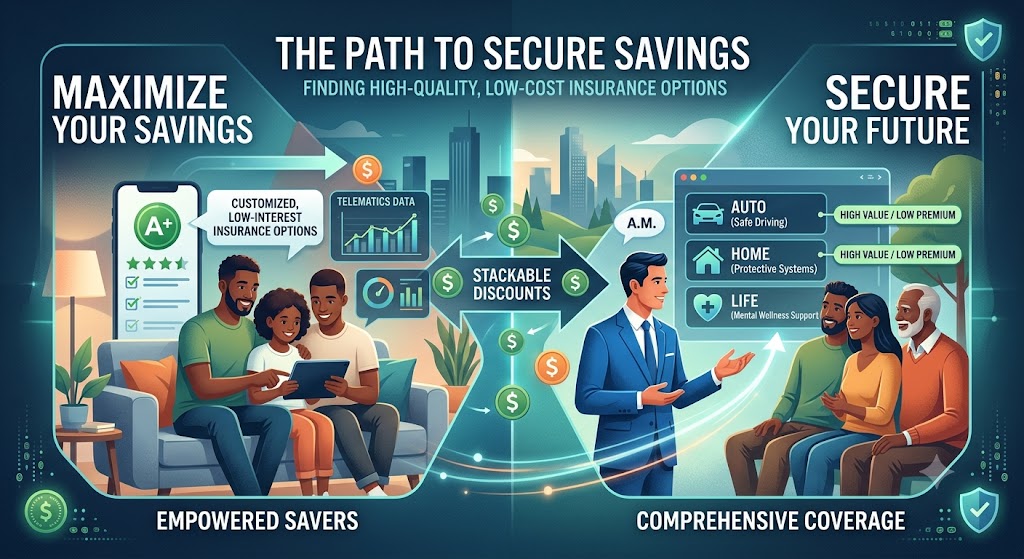
However, searching for a "low insurance company" can feel like walking through a minefield. We’ve all seen the horror stories: a premium that looks unbelievably cheap on paper, only to leave the policyholder stranded with a massive out-of-pocket deductible—or worse, a flat-out denied claim—when an emergency strikes.
But here is the industry secret: "Affordable" does not have to mean "cheap." You can protect your wallet and your peace of mind at the exact same time. Here is a professional guide on how top-tier, low-cost insurance providers keep their rates competitive, and how you can spot a policy that actually protects you.
1. Look for Tech-Driven Efficiency (Telematics)
The most reliable low-cost insurance companies don't cut corners on your coverage; they cut down on their own internal overhead.
Modern insurance providers leverage technology to offer hyper-personalized rates. If you are looking for affordable auto insurance, ask about telematics programs (often called "pay-how-you-drive" or safe-driver programs).
How it works: By using a simple mobile app or a small plug-in device to monitor safe driving habits—like smooth braking and keeping within speed limits—insurers can reward you with massive premium discounts.
If a company offers these digital tools, it’s a green flag that their low rates are backed by modern data, not a lack of financial backing.
2. Decode the Deductible Equation
The fastest way an insurance company lowers your monthly premium is by raising your deductible. While this is a highly effective way to keep your monthly fixed costs low, you must play this strategy smartly.
Before signing on the dotted line, run this quick mathematical check:
-
The Monthly Premium: What you pay to keep the policy active.
-
The Out-of-Pocket Deductible: What you must pay before the insurance company covers a claim.
If your deductible is $1,000, ask yourself: “Do I have $1,000 in an emergency savings account right now?” If the answer is yes, opting for a higher deductible to unlock a low monthly premium is a brilliant financial move. If the answer is no, it’s worth paying a slightly higher monthly rate to ensure you aren't financially paralyzed during an accident.
3. Leverage the Power of "Stackable" Discounts
High-value, low-cost insurers don't just hand out one flat rate; they give you a toolkit of options to actively lower your own premium. When evaluating a budget-friendly company, look closely at their discount roster. The best companies allow you to stack savings:
| Discount Type | How It Saves You Money |
| Multi-Policy Bundling | Combining auto, home, or renters insurance under one roof typically shaves 10% to 25% off the total bill. |
| Paperless & Autopay | Opting for electronic statements and automatic monthly bank transfers eliminates administrative fees. |
| Affiliation Discounts | Look for rate drops tied to your employer, military service, student status, or professional alumni associations. |
4. Check the Financial Stability Ratings
Never buy a policy based on the price tag alone. Before you input your credit card details, take 60 seconds to check the company’s independent financial health ratings.
Look for the company’s rating on A.M. Best or Demotech. You want to see a rating of "A" (Excellent) or better.
Why does this matter? A high financial rating ensures that even if the company's premiums are among the lowest in the industry, they possess the deep cash reserves necessary to pay out your claim seamlessly if a major disaster occurs.
Conclusion: Take Control of Your Insurance Costs
An affordable insurance company shouldn't make you feel exposed; it should make you feel smart. By prioritizing tech-savvy providers, leveraging strategic deductibles, and stacking discounts, you can secure robust, institutional-grade protection at a fraction of the traditional cost.
Ready to see how much you could be saving? Don't pay a premium for over-priced coverage. Get a personalized, zero-obligation quote in less than 5 minutes today and find out just how affordable true peace of mind can be.